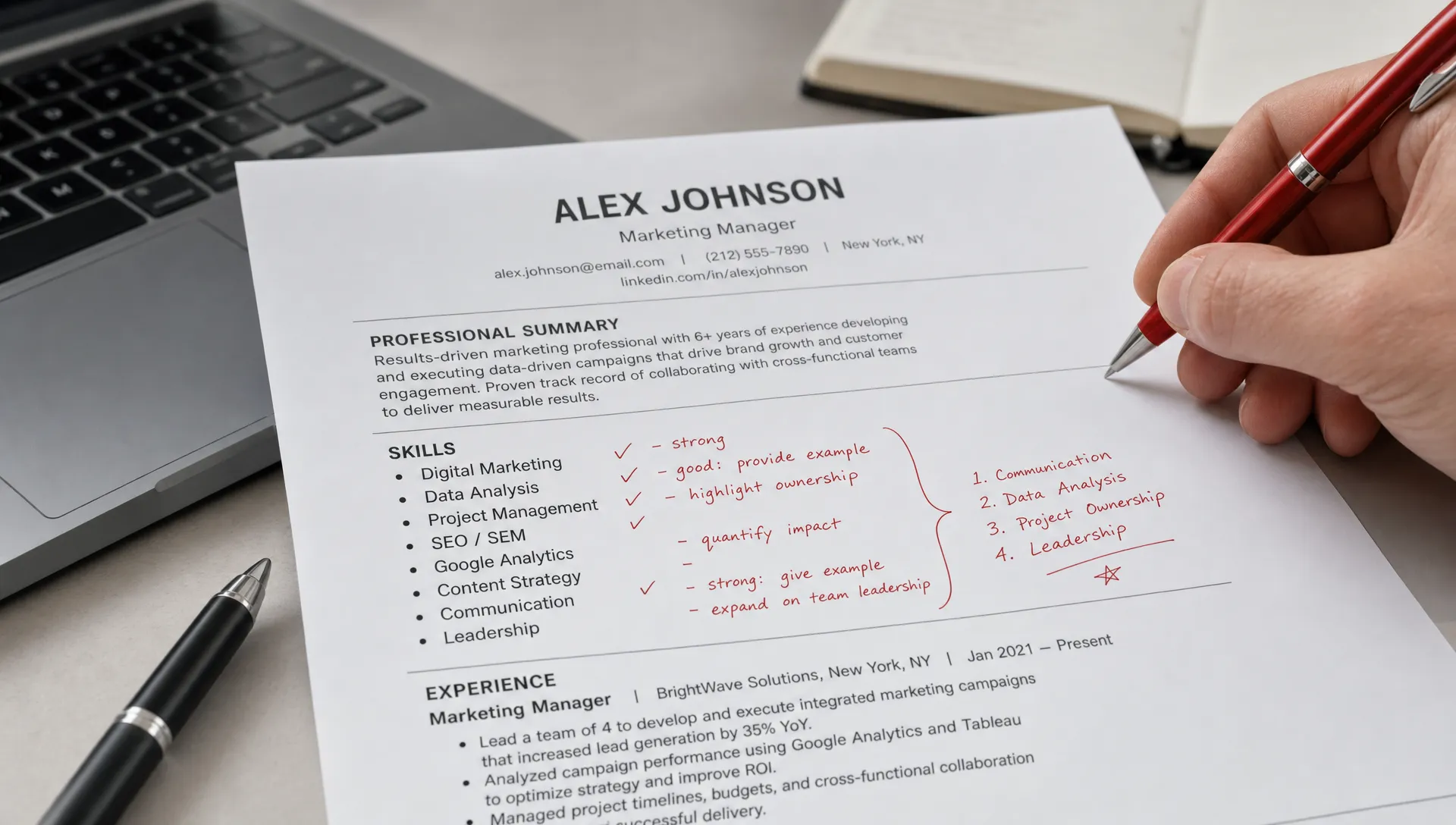
resume skills are not a decorative list at the bottom of your document. They are signals recruiters use to decide whether your experience matches the job, whether you can solve the employer’s problems and whether your application deserves a closer read. The strongest resumes do not simply name skills. They prove them through achievements, context and language that mirrors the role.
That distinction matters because most recruiters are not reading slowly at first. They scan for fit, then they look for evidence. If your skills section says “communication, leadership, teamwork” but your work history never proves those strengths, the words feel generic. If your bullets show how you used those abilities to improve revenue, reduce errors, support customers or lead projects, you become easier to trust.
Why Resume Skills Matter More Than a Keyword List
A resume has to work for two audiences: applicant tracking systems and human reviewers. ATS software can help employers organize applications and search for relevant terms, but it does not replace recruiter judgment. If you want a clear explanation of what these systems actually do, Hot Resume Jobs breaks down common ATS myths in its guide on whether ATS rejects your resume.
Recruiters look beyond keyword matching because every candidate can copy words from a job posting. What separates a stronger applicant is proof. The National Association of Colleges and Employers identifies competencies such as communication, critical thinking, teamwork and technology as core career readiness areas, which aligns closely with what hiring teams evaluate across many roles.
The best resume skills are specific to the role, backed by measurable evidence and placed where recruiters naturally look: the summary, core skills section and accomplishment bullets.
The 10 Resume Skills Recruiters Notice First
Use this list as a filter, not a script. Your resume should reflect the job you want, the results you can prove and the language used in the posting. If a role is highly technical, technical strengths may lead. If it is client-facing, communication and stakeholder management may carry more weight.
| Skill | What recruiters want to see | Stronger phrasing example |
|---|---|---|
| Communication | Clear updates, influence and audience awareness | Presented weekly performance insights to sales leaders, helping prioritize outreach |
| Data literacy | Ability to interpret numbers and act on them | Analyzed ticket trends and identified workflow gaps that reduced repeat issues |
| Project ownership | Follow-through from planning to execution | Managed launch timeline across design, operations and customer success |
| Stakeholder management | Professional handling of competing needs | Coordinated with finance and legal teams to finalize vendor approvals |
| Problem solving | Practical decisions under constraints | Resolved recurring billing errors by redesigning the escalation process |
| Technical fluency | Tools, systems and methods relevant to the role | Built dashboards in Excel and Power BI to monitor monthly KPIs |
| Leadership | Initiative, coaching and decision-making | Trained 8 new hires on service standards and quality procedures |
| Process improvement | Better speed, quality or cost control | Streamlined intake process, cutting manual review time by 30 percent |
| Collaboration | Cross-functional execution | Partnered with product and support teams to improve onboarding materials |
| Adaptability | Learning quickly and adjusting to change | Transitioned team to new CRM while maintaining daily service targets |
1. Communication That Moves Work Forward
Communication is not just writing emails or speaking clearly. On a resume, it should show that you helped people understand priorities, make decisions or take action.
Weak phrasing usually sounds like “excellent verbal and written communication skills.” Better phrasing ties communication to an outcome. For example, a customer service manager could write, “Created escalation templates that improved response consistency across a 12-person support team.” A project coordinator might say, “Delivered weekly status reports that helped leadership identify timeline risks before launch.”
This is one of the most common resume skills, so it needs evidence to avoid sounding like filler.
2. Data Literacy and Analytical Thinking
You do not need to be a data analyst to show data literacy. Recruiters value candidates who can read trends, identify patterns and use information to make better decisions.
For a sales role, that may mean tracking conversion rates or pipeline movement. For operations, it might involve reviewing inventory, cycle time or error rates. For HR, it could mean analyzing turnover, time-to-fill or engagement survey results.
A stronger bullet might read, “Reviewed weekly support ticket data and identified three recurring product issues, helping reduce repeat customer complaints.” The point is not to sound technical for the sake of it. The point is to show judgment.
3. Project Ownership
Project ownership tells a recruiter that you can carry responsibility, not just complete assigned tasks. It means you understand goals, deadlines, dependencies and communication points.
This skill is especially useful for candidates who do not have formal project manager titles. If you coordinated a system rollout, planned an event, led a hiring process, supported a migration or managed a client deliverable, you likely have project ownership experience.
For most roles, resume skills become more convincing when they are attached to scope. Name the timeline, team size, budget, tools or business impact when you can. “Managed onboarding checklist updates for 40 new hires” is much stronger than “helped with onboarding.”
4. Customer or Stakeholder Management
Recruiters notice candidates who can work with people who have different priorities. Stakeholder management applies to external customers, internal departments, vendors, executives, patients, students or community partners.
Good stakeholder language shows professionalism under pressure. It may include resolving complaints, gathering requirements, translating technical updates for non-technical users or aligning multiple teams around a decision.
A useful structure is: who you worked with, what tension or goal existed and what improved. For example, “Partnered with sales, compliance and operations to standardize contract review steps, reducing last-minute approval delays.”
5. Problem Solving Under Constraints
Every job has constraints: limited time, limited budget, imperfect systems, difficult customers or shifting priorities. Recruiters want people who can make progress anyway.
Avoid writing “strong problem solver” without context. Instead, describe the problem and your response. A warehouse supervisor might write, “Reworked shift handoff process after recurring inventory discrepancies, improving count accuracy during peak season.” A marketing associate might write, “Reallocated paid search budget toward higher-converting campaigns after weekly performance review.”
The more concrete the problem, the more believable the skill becomes.

6. Technical Fluency Relevant to the Role
Technical fluency does not mean listing every tool you have ever opened. It means showing the platforms, systems, certifications or methods that matter for the role.
A finance resume may emphasize Excel, financial modeling, ERP systems or reporting tools. A healthcare resume may include EHR platforms, compliance knowledge or patient scheduling software. A marketing resume may highlight CRM systems, analytics platforms, email tools or content management systems.
Be honest about proficiency. Recruiters and hiring managers can usually spot inflated claims during interviews. If you list SQL, Salesforce, Workday, QuickBooks, Tableau or Python, be prepared to explain how you used it.
7. Leadership Without Relying on a Title
Leadership is often misunderstood. You do not need a manager title to show it. Training new employees, mentoring teammates, improving procedures, leading a shift or representing your team in meetings can all demonstrate leadership.
Generic resume skills like “leadership” become stronger when you show who followed your guidance and what changed because of it. Compare “team leader” with “Trained 6 seasonal employees on order accuracy standards, helping the team meet daily fulfillment targets during holiday volume.”
That second version gives the recruiter a scene they can understand. It also sets up a stronger interview conversation.
8. Process Improvement
Process improvement is attractive because it connects your work to efficiency, quality and cost control. Hiring teams like candidates who leave systems better than they found them.
Look for moments when you reduced manual steps, improved documentation, shortened wait times, prevented rework or made handoffs smoother. Even small improvements matter if they affected the team.
Do not force a number if you do not have one. A measured result is helpful, but a credible qualitative result is better than a made-up metric. You can say, “Updated intake form to capture missing client details earlier, reducing back-and-forth between account managers and implementation staff.”
9. Collaboration Across Functions
Collaboration is stronger than teamwork because it implies coordination across different people, departments or goals. Recruiters want to know whether you can operate outside your immediate lane.
Examples may include working with product and customer support, sales and finance, nurses and administrators or teachers and family support teams. The key is to show how your collaboration affected delivery.
If your resume bullets feel flat, the issue may not be your experience. It may be that your results are buried under task language. This guide to writing resume bullet points that survive follow-up questions can help you turn collaboration into proof without exaggerating.
10. Adaptability and Learning Agility
Adaptability matters because tools, processes and business needs keep changing. Recruiters notice candidates who can learn quickly without losing performance.
Strong examples include adopting new software, shifting into a different market, supporting a restructure, taking on expanded duties or learning a new process under deadline pressure. The goal is to show calm, useful adjustment.
A polished line might read, “Learned new scheduling platform during department transition and created quick-reference notes that helped colleagues reduce entry errors.” This shows adaptability, technical learning and team support in one sentence.
How to Choose the Right Skills for Each Application
You do not need to rewrite your entire resume for every job. You do need to adjust emphasis. Start by comparing the posting against your current resume and highlighting repeated requirements, tools, responsibilities and outcomes.
Then decide which resume skills deserve more visibility. If the job description repeats “vendor management” three times and your resume hides that experience in one old bullet, move it higher. If a posting asks for Excel and reporting, make those details visible in your skills section and work history.
A practical approach is to keep a strong master resume, then tailor the summary, skills section and top few bullets for each role. If you are unsure how much customization is enough, use the 5, 15 and 45-minute resume tailoring framework to decide how much effort a specific application deserves.
Where to Put Skills on Your Resume
Your skills section is useful, but it should not carry the whole message. Place the most important capabilities in three areas so recruiters see them quickly and believe them.
In the professional summary, use two or three high-value strengths tied to your target role. In the skills section, list relevant tools, methods and competencies in clean groups. In your experience section, prove the most important strengths through achievements.
For example, do not only list “project management” under skills. Show a bullet like, “Coordinated 90-day software rollout across operations, training and customer support teams, meeting launch deadline with no service interruption.” That is the difference between a claim and evidence.
Common Mistakes That Make Skills Look Weak
Many qualified candidates undersell themselves because their skills sound detached from results. Recruiters see the same vague phrases constantly, so clarity matters.
Avoid these common issues:
- Listing too many unrelated tools or soft skills
- Copying the job description without proving experience
- Using subjective phrases like “hardworking” or “detail-oriented” with no evidence
- Burying your strongest capabilities near the bottom of the resume
- Claiming expert-level proficiency you cannot discuss in an interview
Your goal is not to look perfect. Your goal is to look relevant, credible and easy to place into the open role.
Frequently Asked Questions
What resume skills should I list if I am changing careers? Focus on transferable strengths that match the target role, such as communication, project coordination, stakeholder management, data analysis, training, customer service or process improvement. Then use bullets to show how those strengths created results in your previous field.
Should I include soft skills on my resume? Yes, but do not rely on a plain list. Soft skills such as leadership, communication and collaboration are more persuasive when they appear in accomplishment bullets with context and outcomes.
How many skills should be in a resume skills section? Most resumes work well with 8 to 15 highly relevant skills, depending on the role and seniority. A technical candidate may need more tool-specific keywords, but the section should still feel focused.
Should I copy skills from the job description? You can mirror relevant language when it truthfully matches your experience. Do not copy requirements you cannot support, since recruiters and hiring managers often test those claims during interviews.
Do recruiters care more about skills or experience? Recruiters care about both. Skills help them identify fit quickly, but experience proves whether you have used those skills in real work situations.
Make Your Skills Sound Like Recruiter Language
If your experience is strong but your resume is not getting responses, the problem may be translation. You may be describing your background in internal company language instead of the language recruiters, ATS systems and hiring managers expect.
Hot Resume Jobs helps job seekers turn scattered experience into focused career positioning, including ATS-optimized resume rewrites, LinkedIn profile optimization and cover letter support. If you want a clearer view of which resume skills belong on your document and how to prove them, start with a free resume assessment.